Dance, destiny & detours
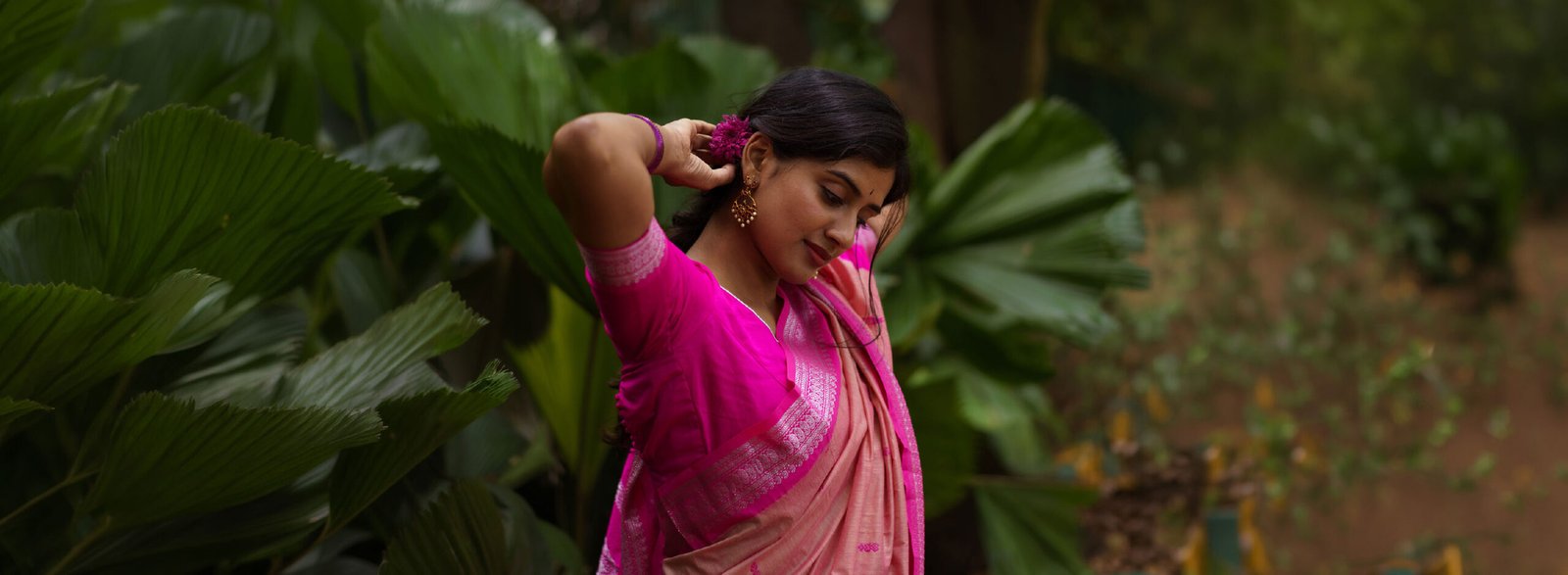
From classical dance to horror, drama and multilingual cinema, Sushmitha Bhat is deliberately chasing contrast.
Sushmitha Bhat moves between worlds with ease. Kannada television audiences know her from Kavyanjali, while her film work has taken her across Kannada, Telugu, Malayalam, Tamil and Hindi. Recent roles have placed her in strikingly different spaces: an ethereal presence in Dies Irae, a dancer carrying strong emotional textures in Dominic, and Radha in Krishnavataram. Behind that growing filmography sits another constant: Bharatanatyam.
Dance entered her life through her mother’s insistence. At first, Sushmitha did not even feel she belonged in a Bharatanatyam class. Her parents were struggling to make ends meet at the time, and her adolescent self wondered whether the money being spent on dance could be put to better use elsewhere.
Her relationship with it changed much later, when what she calls her “major goals of life” did not work out as planned.
“It had the ability to make me forget myself and keep me singularly focused on my mind and body,” she says. Today, she credits her gurus and her training with opening “a door full of possibilities.”
That relationship with movement now travels naturally into her screen work.
A DIFFERENT BODY FOR EVERY ROLE
Sushmitha speaks about her characters almost like a dancer describing choreography. Each one asks for a different physical and emotional vocabulary.
“If you are seeing yourself as an actor and not as a heroine, this type of versatility will excite you,” she says. “One forces me to be a shadow, one forces me to be pure muscle and emotion, and the other asks me to be a piece of classical art.”
That appetite for contrast is becoming central to the career she is building. Her creative wishlist includes a psychological thriller driven by physical theatre, an antagonist role that strips away her physical elegance entirely, and an action-adventure demanding muscular endurance.
Behind those ambitions is an understanding that emotion can travel further than language. Having worked across five Indian film industries, Sushmitha believes audiences respond first to authenticity.
“The barrier of language is effectively dismantled by visual storytelling and non-verbal emotional cues,” she says. “Audiences are responding to the authenticity of your emotion.”
For her, language is becoming less of a boundary. Social platforms have made it easier for performers and audiences to discover work across industries, while adaptability has become increasingly important for actors moving between cultures and languages.
Dance itself continues to expand beyond performance. While working on Tulasi, a contemporary adaptation of a Purandara Dasa composition, she experienced the challenge of creating fresh movement within a deeply rooted classical form.
She is quick to redirect much of the choreographic credit to her guru, but the experience left her wanting more. She would happily return to such projects as a performer, choreographer or even a creative collaborator assisting a director, cinematographer or art director.
THE LIFE THAT CAME BEFORE
Cinema was hardly the only career available to her.
Sushmitha has a BTech in Electronics and Communication Engineering and actually worked in IT—the life she had expected her degree to lead towards. She was content with it too.
For a while, the two careers ran alongside each other. Only recently did she leave her IT job after finding it increasingly difficult to balance acting with a conventional nine-to-five schedule.
Her entry into cinema, meanwhile, remains something she describes as “incidental”—a combination of accident, timing and destiny, but also curiosity.
“My curiosity towards picking up something merely to have a new experience and learning led me into a world of possibilities,” she says.
Television offered an early reality check. Kavyanjali gave her an audience, but Sushmitha does not romanticise the experience. Managing costumes, memorising dialogue and getting the performance right within the demanding rhythm of television taxed both her mind and body.
She did not particularly enjoy that phase at the time. Looking back, however, she recognises what it gave her: resilience.
PAGES, PLAYLISTS AND PLACES
Reading
- 12 Rules for Life — Jordan Peterson
- The Mountain Is You — Brianna Wiest
- Grit — Angela Duckworth
Podcasts
- The Diary of a CEO
- Big Think
- Dushyanth Sridhar
- Vinay Varanasi
Music
- Sean Roldan’s Poo Paadal
- Classics by S. Janaki, Ilaiyaraaja and SPB
- Adrian Legg’s instrumentals for focus
Screen-Inspired Travel
- Atlantic Ocean Road, Norway: No Time to Die
- Hobbiton, New Zealand: The Lord of the Rings
- Northern Ireland: Game of Thrones
- Scotland: Hogwarts Express landscapes
THE PLACES THAT FEEL LIKE HOME
Born in Chennai, raised in Bengaluru and connected to Udupi through her grandparents, Sushmitha has different relationships with different corners of South India.
Bengaluru is unequivocally home. It is where she went to school and college, developed her hobbies and formed the friendships, mentorships and relationships that shaped her.
“It always felt like I could survive anything as long as I am here, home!” she says.
Udupi holds a different kind of memory.
Her ideal day there is deliberately uncomplicated: staying close to home, visiting nearby temples whose stories she first heard from her grandmother, returning to the small stream behind the house where she played with her cousins as a child, and ending the day at the beach.
Food means neer dosa or ottu shavige, while rice and majjige huli at home is her idea of an ideal lunch.
For readers looking for something even slower, she points towards places around Kamalashile, Suparshva Cave, Neelavara and Mangaluru, which she visited recently.
“Everyone around here [is] leading a slow life,” she says. For her, that quiet creates precisely the space needed to reconsider things and rejuvenate.
FROM ACCIDENT TO INTENTION
If Sushmitha’s arrival in acting was incidental, the way she approaches it now is anything but.
She no longer wants to depend solely on unexpected opportunities finding her. She auditions actively, networks within the industry, looks for opportunities to submit her portfolio and deliberately establishes connections with people whose work interests her.
“Now I am very intentional about the roles I want to pick, teams I want to work with and the impression I want to leave on people.”
That intention extends beyond simply accumulating roles.
What she ultimately wants to create is an experience strong enough to stay with an audience. Sushmitha calls herself a “big tragedy lover”; she wants stories capable of moving someone to tears—including herself.
“The quest for building an unimaginable experience for audience will always be in me,” she says. Whether she ever fully achieves it almost seems beside the point. “The quest never ends.”
Her personal ambitions are quieter but no less deliberate: a healthy routine built around conscious choices, greater mindfulness and the desire to be a reliable, positive presence for the people around her. Love and kindness, she says, are qualities she wants to impart rather than simply ideas she wants to hold.
Perhaps that is where the different strands meet: Bharatanatyam, television, engineering, cinema, books, travel and the unexpected detours between them.
Sushmitha’s career may have begun through curiosity and unexpected turns, but she no longer intends to leave everything to chance. She knows the kinds of characters she wants to explore, the collaborators she wants to find and, perhaps most importantly, the feeling she eventually wants her work to leave behind.
For a performer whose earliest creative language was movement, that progression feels fitting. The steps may once have arrived by accident. Now she is increasingly choosing the direction herself.
Every new role simply gives Sushmitha another rhythm to discover.

India’s First In-Train Magazine 001
India’s first in-train magazine offers travelers engaging content like travel tips, destination highlights, and entertainment, making the journey more enjoyable and informative.

Follow Us
Popular Categories