The rooftop mixtape
How one band turned an entire audience into the main act.
Chances are you’ve stood in a crowd somewhere, singing your lungs out to a Rahman or Ilaiyaraaja song, without a single microphone in sight. That’s Motta Maadi Music at work. Its founder, Chennai-based musician, composer and sound engineer Badhri Narayanan Seshadri, tells us how a terrace jam with no plan turned into a show he now considers bigger than himself.
The band started off as a group of friends jamming on weekends, with no bigger goal than making music. Badhri describes himself as “kind of jobless at the time and going through the whole artist-circle phase” when the thought occurred: why not get the band together and simply jam on the terrace?
The first session had no title; it got one only when the group needed something for a Facebook post announcing the second show. The answer was right above them: motta maadi, Tamil for terrace, the very rooftop where it was all happening.
Some people criticised the name; others thought it was quirky. Badhri liked its simplicity, and particularly the fact that it carried a Tamil word. So it stayed.
GETTING THE SOUND RIGHT
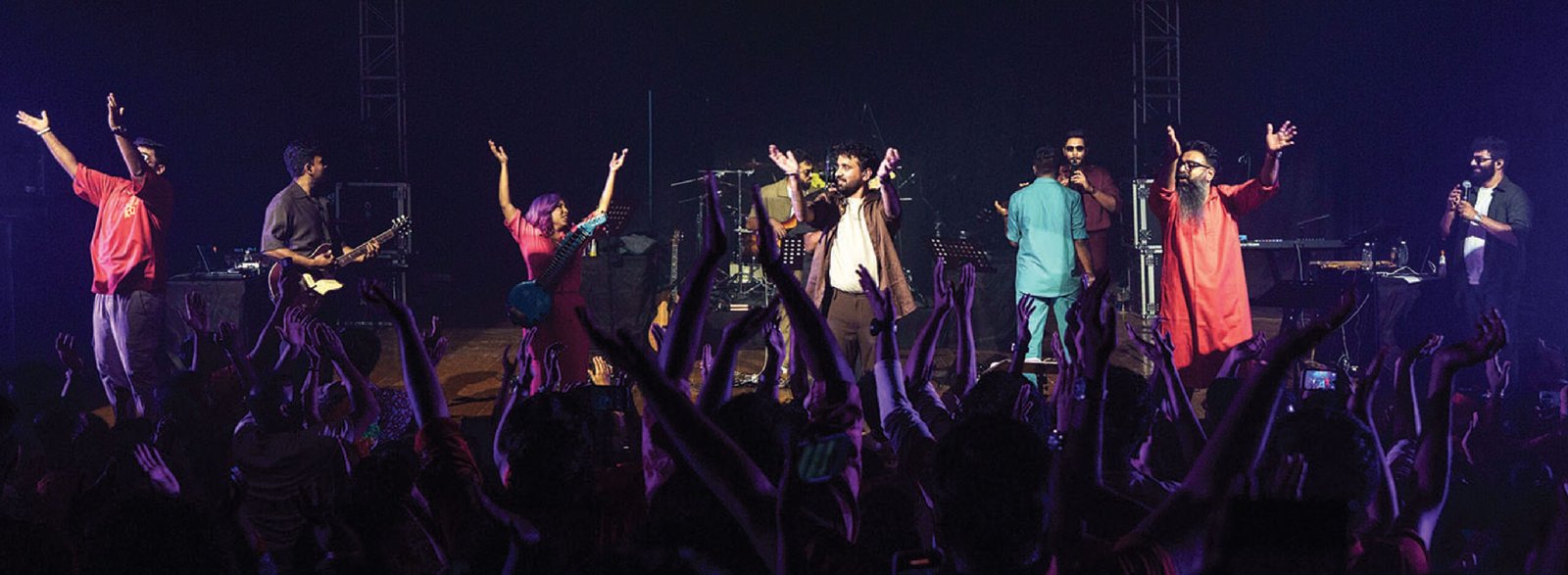
The rule that defines every show is simple: the crowd sings, the band just accompanies.
That was easy on a terrace with a couple of amps. There were no huge speakers, partly because they were playing in a residential neighbourhood, and the number of people singing could comfortably overpower the modest technical setup.
Doing the same thing in an auditorium, with a full sound system and rows of seats, took years to get right.
The solution involved more than simply adjusting volume. There would be no singers on stage and nobody holding a microphone. Visually and psychologically, Badhri wanted the audience to understand one thing: you are the singer; the musicians are effectively your backing band.
“After the soundcheck, we would bring the master volume down so people could hear the music but also hear themselves singing over it,” says Badhri.
The early auditorium shows required some adjustment because audiences did not necessarily know what they had signed up for. Two or three years later, that had changed. People arrived knowing exactly what a Motta Maadi show required of them.
Once audiences became comfortable with that, the band could finally sound tighter and bigger without drowning anyone out.
WHY THESE SONGS?
The answer goes back well before Motta Maadi Music.
Badhri grew up in Srirangam, Trichy, where music was one of his primary forms of entertainment. Radio and television channels exposed him to everything from songs of the 1950s and ’60s to whatever happened to be current.
That range eventually became part of Motta Maadi’s musical vocabulary.
For Badhri, film music works because people rarely experience it as music alone. A song can carry a memory, a lyric can mirror something happening in your own life, and an entire crowd can recognise the same emotion simultaneously.
For two or three hours, he says, “everybody is pretty much on the same wavelength.”
There is also a considerably simpler explanation.
He is a fan.
Raja, Rahman, Harris—the composers he grew up admiring remain part of his own musical world. Watching hundreds or thousands of people celebrate the same music is, as he describes it, a little like being a fanboy who discovers that everyone else loves his favourite person too.
WHEN IT BECAME BIGGER THAN THE BAND
For all its growth, one of Motta Maadi Music’s defining moments did not happen during a sold-out show.
Around 2021, Badhri was four or five years into the project and feeling saturated and demotivated. He was beginning to wonder what came next—and whether he wanted to continue at all.
Then someone who had attended one of the shows approached him.
She told him she had also been at a Motta Maadi session in 2018, during a difficult period in her life. Being able to join a crowd and sing without inhibitions had helped her through it.
Years later, she had returned.
“She said, ‘I’ve crossed those tough times and I’m mentally better. And I can see that you’re doing really well too… we’ve both gotten better. These are happy times.’”
The conversation altered Badhri’s understanding of what he had created.
Without consciously setting out to do so, something that had begun as friends jamming on a terrace had acquired meaning in someone else’s life.
“This is not mine anymore,” he realised.
“We started something as a collective, and it had gained its own meaning. You cannot selfishly decide to stop something when it no longer belongs only to you.”
He kept going. A world tour eventually followed.
Over the past two years, another part of the shows has become especially meaningful to him: groups of around 30 to 50 visually challenged people have been hosted at Motta Maadi performances. Seeing them sing, enjoy themselves and speaking with them afterwards, he says, has become one of his favourite parts of what they do.
A SPACE OF ITS OWN
Interestingly, one ambition didn’t follow Motta Maadi as it grew.
Badhri had once imagined using its audience to introduce independent artists and original music. The band itself had begun through musicians meeting in studios to create new work, so bringing indie music into the shows seemed like a natural progression.
In practice, he realised the two needed different spaces.
An audience that had arrived expecting familiar film songs might not respond fairly to an independent artist suddenly appearing midway through the set. Equally, having someone interrupt an indie performance to ask when the film songs would begin would be unfair to the artist.
So instead of forcing the two together, he separated them.
Motta Maadi remained what audiences had made it: a dedicated jamming and singalong space. His independent-music journey would continue elsewhere.
THE APP THAT KEEPS THE BAND IN SYNC
Talk tech, and Badhri points straight to WinkU, an app the band uses with its in-ear monitors.
“You set up your own Wi-Fi inside the venue as a server, and all the musicians connect to it so everybody can control their individual in-ear mix,” he explains.
The sound engineer still handles the main mix, but for a compact five- or six-piece band like Motta Maadi Music, the app lets individual musicians adjust what they hear during a performance without requiring the infrastructure of a much larger concert setup.
ON CHENNAI’S INDEPENDENT MUSIC SCENE
South India’s independent music scene has been on a slow, steady climb, gaining listeners without the sudden spikes that come and go just as fast. That gradual pace is exactly what Badhri would choose.
“I actually like slow growth because I think it stays forever. So it’s going well. Slowly, people are gaining more listeners for the Indian independent music scene,” he says.
What he would like to see change is Chennai’s place on the international touring circuit. He has travelled to Ahmedabad for Coldplay, Bangalore for Jacob Collier and Mumbai for John Mayer. Ed Sheeran has played Chennai, but Badhri would like more international artists to make the city a regular stop.
Because otherwise, he points out, a concert ticket also means flights and hotels.
“I wish sometimes it could all happen at home… Just take a backpack and go to the show.”
LIFE OUTSIDE THE SETLIST
The cities, sounds and experiences Badhri keeps returning to offstage.
- Jazz fix: Berlin and London — three-hour jazz-bar sessions were among his first priorities in both cities.
- Concert memory: A.R. Rahman, live in London. Seeing one of his biggest musical inspirations perform while they were both away from home made the experience particularly memorable.
- New city ritual: Finds a local band, books a ticket and drops into a show—even when he doesn’t understand the music.
- Next up: USA, with a few bands already bookmarked.
- Nature pick: Lauterbrunnen, Switzerland. He loved it enough to secretly take the whole Motta Maadi Music team there during a Europe tour.
- City fix: London, particularly for the combination of city life and football.
- Nightlife: Melbourne and Amsterdam.
WHAT HE WANTS REMEMBERED
Talk about legacy, and Badhri’s answer has nothing to do with scale.
He doesn’t talk about the number of shows, cities or tickets sold. What matters is whether people remember how it felt to be there.
“I honestly want people to reminisce and say, ‘Hey, there was this band we all sang along with. We were all happy at the time. It was fun.’”
There were difficult chapters too, particularly restarting after COVID and convincing audiences that it was safe to gather again. But even those years fit into the memory he hopes Motta Maadi eventually leaves behind.
“I would just want people to think, ‘Hey, this was started by them. I was there, and it was fun.’”
Ten years from now, he just wants people still in that crowd, singing along.

India’s First In-Train Magazine 001
India’s first in-train magazine offers travelers engaging content like travel tips, destination highlights, and entertainment, making the journey more enjoyable and informative.

Follow Us
Popular Categories