The Fishing Village That Traded With Rome
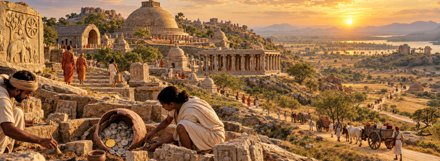
On the quiet coast of Ramanathapuram, an ordinary fishing village is sitting on nearly 900 years of maritime history—including links to the Roman world.
Drive east from Ramanathapuram, and Alagankulam does not announce itself. It looks like a quiet coastal village, with fishermen tending their nets, children cycling through narrow streets, and fields stretching towards the Vaigai and the sea only a few kilometers away. Nothing about the landscape suggests that this settlement once belonged to a much larger world. That is precisely what makes its story remarkable.
Archaeologists excavating Alagankulam since the 1980s have uncovered amphora fragments associated with Mediterranean trade, rouletted ware, fine ceramics, beads, bricks, and pottery carrying Tamil-Brahmi letters. The Tamil Nadu Department of Archaeology classifies Alagankulam as an early historic site, with excavations conducted across multiple seasons since 1986. The department records Mediterranean-region potsherds, including amphorae, along with Tamil-Brahmi inscribed pottery and other antiquities from the site.
For centuries, Alagankulam was more than a local coastal settlement. Its archaeology points to a trading network tha`t linked ancient Tamilakam with other parts of India and the wider Indian Ocean world. Among the most striking finds are three Roman coins bearing the image of Emperor Valentinian II, who ruled in the late fourth century CE. A Roman emperor, cast on a coin thousands of kilometers away, eventually buried in the soil of Ramanathapuram.
Perhaps the most human discovery, however, is a broken piece of pottery carrying the scratched image of a ship. Scholars have compared the image with ancient Mediterranean ship representations, although its exact identification remains open to interpretation. What matters is the image itself: someone on this coast more than two thousand years ago knew ships well enough to draw one. That simple sketch brings the past closer than any date ever could. A date belongs to history. A doodle belongs to a person.
The pottery tells an equally interesting story. Scientific studies of ceramics from Alagankulam suggest that its trading world was more complex than a simple flow of Roman imports. Some ceramics were imported, some travelled from elsewhere in India, and others were locally produced in styles connected to wider exchange networks. Alagankulam was not simply receiving foreign goods; it was participating in a connected economy.
Today, there is no towering monument announcing any of this. No surviving harbour wall, palace, or grand gateway. Just a quiet village continuing with everyday life, while beneath it lie traces of centuries when this coast was connected to the wider ancient world.
Alagankulam did not sit at the edge of the ancient world. For centuries, it was connected to its routes.
India’s First In-Train Magazine 001
India’s first in-train magazine offers travelers engaging content like travel tips, destination highlights, and entertainment, making the journey more enjoyable and informative.

Follow Us
Popular Categories