A COIN, A CLOCK, A COUNTRY
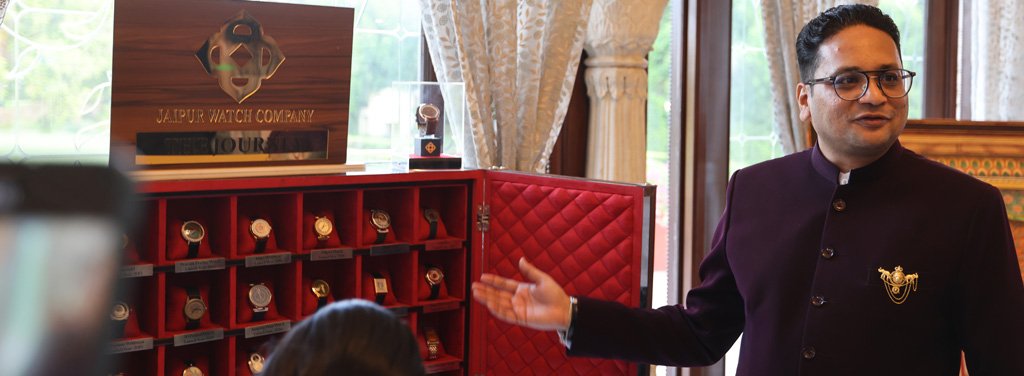
A collector’s passion, a watchmaker’s precision and a dream of creating tomorrow’s heirlooms.
On the morning of our conversation, Gaurav Mehta wore a piece of history on his wrist. A half-rupee coin minted in the year India gained independence sits at the heart of the Royal Baagh 1947, a timepiece from his Jaipur Watch Company. “I chose it this morning because I needed a reminder of resilience and roots,” he says.
For Mehta, the coin represents more than an unusual design element. Its walking tiger motif connects the watch to a particular moment in India’s history, making it both a personal reminder and a conversation starter.
The Collector’s Eye
Long before he became a founder, Mehta collected coins, stamps and vintage HMT watches. Founded in 2013, Jaipur Watch Company grew from one idea: give pieces of India’s past a place on the wrist.
If you simply take a mass-produced standard watch, print a traditional motif on the dial, and call it an ‘Indian watch,’ that is just lazy surface decoration,” he says. Heritage must live in the anatomy of the watch: the proportions of Jantar Mantar shaping its case, a genuine coin resting at the heart of the dial, and the centuries-old artistry of Jaipur’s Pichwai and Meenakari craftsmen woven into the timepiece itself.
For him, the distinction comes down to “integration versus ornamentation.” Architectural references, historical objects and traditional craftsmanship must become part of the watch’s physical design rather than simply decorating its surface. This philosophy extends to the brand’s Gates of India collection, with its 360-degree flip-case mechanism and architectural references, and the Premium Baagh series, which combines stone dials, Khadi detailing and tiger-inspired elements.
The Making of an Heirloom
India has long been celebrated for its textiles, jewellery and architecture. Mehta believes its watches deserve a place on that list too.
Indian watchmaking has had two defining chapters. HMT brought mechanical watches to the masses, and Titan mastered scale and design. Mehta hopes to write another, one built around Indian luxury and collectibility.
“Collectibility cannot be manufactured overnight through marketing; it is a slow, methodical process built over generations of trust, proper service infrastructure, and mechanical integrity,” he says. He dreams of a house that outlives him, like the independent ateliers of Geneva and Le Locle, creating watches that become treasured heirlooms and earn Indian design a place on the global horological stage.
His approach centres on controlled production, a consistent design identity and long-term reliability. He believes these qualities must be established over decades before a watch can earn lasting recognition among collectors.
He also sees a change in how Indian consumers approach homegrown luxury. Rather than looking exclusively towards established international names, he believes more buyers are seeking products that combine cultural identity with craftsmanship and quality.
THREE WATCHES, THREE STORIES
Gaurav Mehta’s picks for an Indian collection.
- HMT Janata or Pilot | The Classic
A timeless symbol of India’s watchmaking heritage. - Gates of India | The Innovator
Architectural inspiration meets a distinctive flip-case design. - Premium Baagh | The Personal Pick
A striking blend of stone, Khadi and tiger-inspired detailing.
The Heart of the Watch
Inside every mechanical watch sits a movement, the tiny engine that keeps time. The engine comes from Japan or Switzerland, drawing on established watchmaking expertise while India’s independent mechanical-watchmaking ecosystem continues to develop.
Mehta identifies precision industrial infrastructure as a major challenge for domestic mechanical movement production. Components such as balance wheels, escapements and hairsprings demand specialised machinery, materials and manufacturing expertise.
For now, sourcing established movements allows Jaipur Watch Company to concentrate on original case architecture, dial craftsmanship and design while maintaining mechanical reliability.
OFF THE CLOCK
Destinations, discoveries and dream escapes.
- Geneva | The Inspiration
Swiss movements that reshaped his design philosophy. - Nature Escapes | The Favourite
Unhurried, green holidays where his children roam free. - New Zealand | The Bucket List
A dream family trip through scenic wilderness.
The Rhythm of Everyday Life
Away from the studio, his world is family. The morning school run is a ritual he would not trade. At work, CAD shapes every fraction of a millimetre, analytics read collector demand, and AI is quietly woven through a lean team.
His early visit to Geneva also remains an important memory. Seeing the intricate coordination of mechanical components strengthened his conviction that watches inspired by Indian heritage should meet international standards of precision.
Outside work, he prefers spending time with his parents, wife and children. Family holidays, nature and quiet moments offer a contrast to the demands of running a watch company.
His collecting interests remain part of his personal life, too. Rare historical literature and books on numismatics and philately continue to fascinate him, offering another way to explore the stories behind objects.
Asked to choose between a large luxury business and a stranger recognising one of his early watches, he picks the stranger. “Twenty years from now, cultural legacy will matter infinitely more to me than commercial scale or business valuation,” he says. The collector with the coins is still doing the thinking, and his clock runs on a half-rupee from 1947.

India’s First In-Train Magazine 001
India’s first in-train magazine offers travelers engaging content like travel tips, destination highlights, and entertainment, making the journey more enjoyable and informative.

Follow Us
Popular Categories