The Star Beyond the Script

From army postings to courtrooms to cinema, Shraddha Srinath has never taken the obvious path. Turns out, that was always the point.
There is a particular skill that army children develop early, one that never quite leaves them. It is the ability to walk into a room where everyone already knows each other, read it quickly, and decide exactly how to belong.
Shraddha Srinath has been doing this her whole life.
Across Dharchula in Uttarakhand, Bhopal in Madhya Pradesh, Belagavi in Karnataka, and a handful of other postings, every two years meant a new city, a new school, a new version of starting over.
She watched her mother pack their entire house into boxes with the kind of precision that comes only from practice. Right down to the last toothpick. “It taught me very early that home is not just four walls and a roof above your head,” Shraddha says. “Home is the people. It is your family that gives you that sense of safety, comfort, and belonging.”
It also taught her that impermanence is the only constant, and “it is best not to get too attached to people and places.”
For Shraddha, each new place announced itself through feeling before anything else: the sights, sounds, smells, and even the sound of a language she had not heard before. Arriving somewhere unfamiliar took her back to childhood, to the small but necessary work of observing a new world and slowly figuring it out.

HOME GROUND
When Shraddha moved to Bengaluru, she gave herself three, maybe four years. That was simply how she had been trained to think—every place a temporary arrangement, every belonging provisional. But three years became five, and five became ten, and at some point she stopped planning her exit and started paying attention to what she had built instead.
“Bengaluru anchored me,” she says. “It gave me a sense of identity, stability, and routine. Every time I travel and return, stepping out of the airport feels like coming home.”
Eighteen years later, it still does. The city introduced her to live classical music for the first time; she still remembers the jaw-dropping moment of watching an entire orchestra perform, and thinking about the years of discipline that produced a single evening of beauty. It opened up classic rock. It expanded her world in ways she hadn’t anticipated when she arrived as an outsider, once again, figuring things out.
That first live orchestra performance stayed with her not only for its scale, but for what it revealed about the commitment behind it. “What stayed with me most was thinking about the years of dedication and sacrifice required to master a craft at that level,” she says. “I have immense respect for artists who perform live.” Her listening has shifted over the years too, from the Bollywood music she grew up with to classic rock and an increasingly fluid relationship with sound and genre. “Today, my taste is very fluid,” she shares. “I enjoy discovering new genres because I am not the same person I was years ago.”
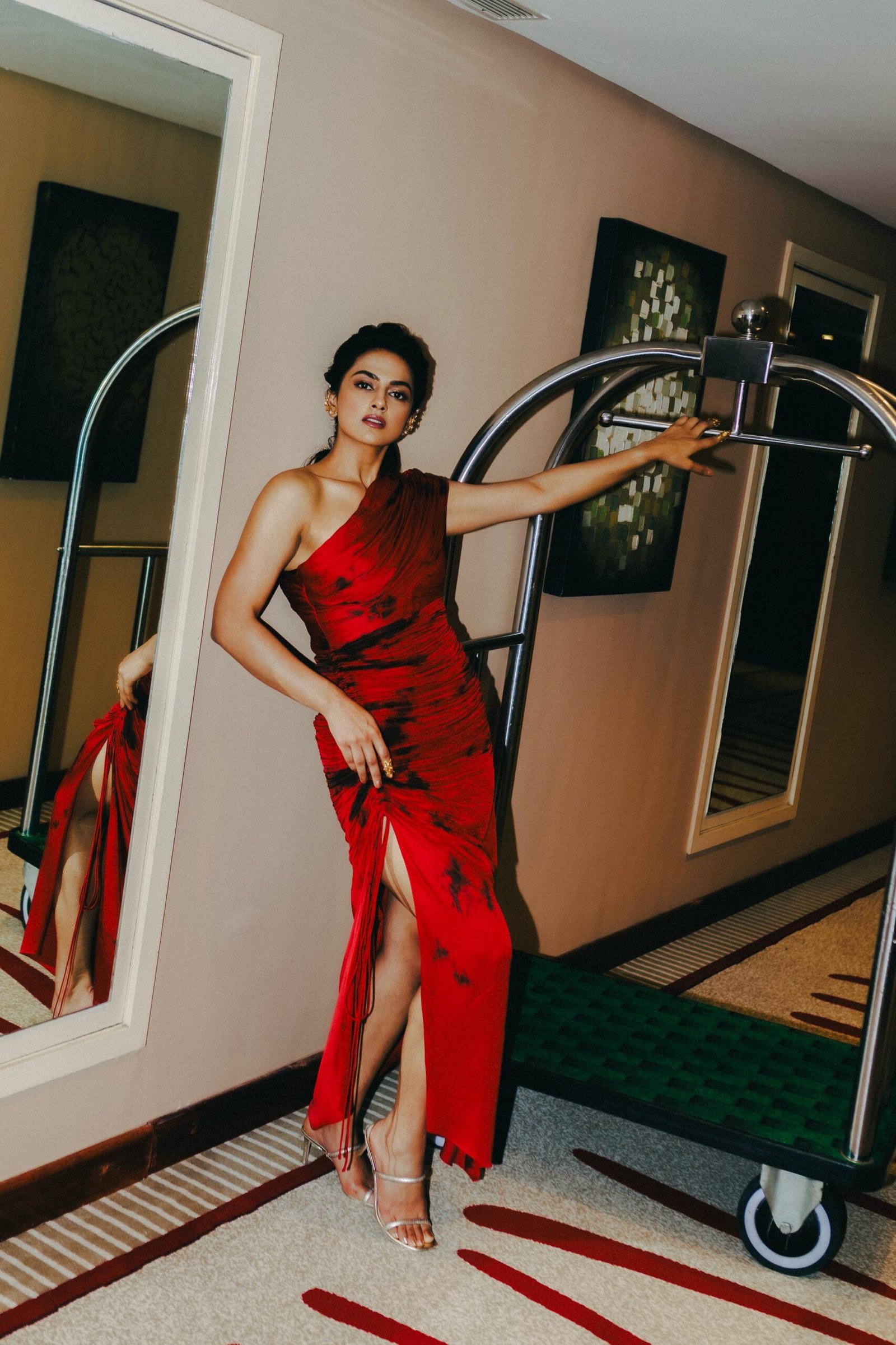
“I love understanding how a place works,” she says, “even down to its local transport system.” It’s the same instinct whether she’s in Bengaluru or Leh or a supermarket aisle abroad, picking up unusual snacks to bring home to friends. She is always trying to understand the place on its own terms before she decides what she thinks of it.
Bengaluru, Hyderabad, Chennai, and Kochi all carry the ease of familiarity now, shaped by the time she has spent working and living in each. Mumbai, however, continues to excite her. “I enjoy the energy, the pace, and the professionalism,” she says. “Everyone is completely immersed in their work, and there is something inspiring about that environment.”
Off set, she moves through life simply and intentionally. She tracks her sleep, her steps, her fitness—perhaps a little obsessively, she admits, but she enjoys the data and the insight it gives her. Her wardrobe follows the same logic: practical, considered, largely thrifted. “Fashion, for me, is not just about clothes but also about their impact on the environment and labour,” she says. “I believe personality matters far more than clothing.”
For her, style works best when it feels personal rather than trend-driven. She enjoys re-wearing and restyling clothes, and while public appearances occasionally call for designer outfits, her private instinct remains uncomplicated: to live simply and choose what feels authentic.

THE ROAD BETWEEN
Travel is one of the places where Shraddha’s old instinct for arriving, observing, and adapting finds its fullest expression. She notices culture, food, shopping, and the simple pleasure of walking through a new place, but she is equally interested in the mechanics of ordinary life—the routes people take, the things they buy, and the rhythms that make a city feel like itself.
She is drawn to local handicrafts and objects that carry the character of a region, but some of her favourite discoveries are often the most everyday ones. Visiting supermarkets abroad, she says, is one of the pleasures of travel: a quick and unfiltered glimpse into what people eat, how they shop, and which unexpected snacks are worth bringing home to friends.
CASE CLOSED, SLATE OPEN
Before cinema, there was law. A corporate career, real estate contracts, a real estate office where a young clerk sat doing ordinary work and wondering, without urgency, what came next. She was trained to read the fine print, to negotiate, to be precise about what she was agreeing to. Those instincts found a new application, long after she left law.
The legal training still appears most clearly when she is reading contracts or negotiating, but the larger inheritance of that chapter is confidence. Working in a corporate environment, she says, gave her professional experience that remains valuable long after the shift from courtroom language to film sets.
When U Turn arrived and changed the register in which filmmakers saw her—bold, intelligent, agentive—she slowed down instead of rushing to capitalise on the momentum. She rejected far more than she accepted. That pile of unmade films, she says decidedly, tells you exactly who she is. “It tells me that I don’t settle for less and I don’t celebrate mediocrity.”
That selectiveness is intentional. She has never minded waiting if it means finding a role she truly believes in. “I feel a responsibility towards the audience and towards the craft itself. A lot of thought goes into every decision. I want to do work that is meaningful and worthy of the opportunities I’ve been given,” she says.
She speaks about that patience without romanticising it. It is possible, she knows, because of a supportive family and a comfortable life—privileges she takes seriously. Waiting for the right role, for her, is not passivity. It is a decision to use the opportunities she has been given with care.
What’s In Her Travel Bag?
Spud: A stuffed toy duck who has seen more of the world than most people
A satin pillowcase for her skin and hair
Her Perfect Fortnight
The hills, immediately, no question
A loose plan, plenty of room to ditch it
Crisp air, birdsong, sunrises and sunsets
The Fridge Wall
One magnet from every place she’s ever travelled
The fridge is, at this point, basically an atlas
Currently Reading
Maybe You Should Talk to Someone by Lori Gottlieb
A therapist in therapy—deeply moving, she says, and genuinely tests her focus
THE WORK BEHIND THE WORK
That deliberateness extends into the characters themselves. For Irugapatru, she built an entire emotional history for Mitra that never once appears on screen—her fears, her conflicts, the experiences that made her the kind of woman who makes the choices she makes. Most audiences will never know it’s there, but that’s not the point. “Even if the audience never sees that history, I believe it helps create a character who feels real,” she says. “Whether or not I am the protagonist, I want my character to contribute meaningfully to the story.”
Not every part requires that level of excavation, she explains. Mitra did because the character’s emotional complexity demanded it. The question that guides her is not simply what a character does, but why: what they fear, what they carry, and what experiences have shaped the decisions they make before the audience meets them.
Real, for Shraddha, means flawed enough to be recognisable. Human enough to be uncomfortable.
She sees the intelligent, self-assured women in her filmography as both a reflection of her choices and of how filmmakers have come to see her after U Turn. “I also genuinely enjoy playing such women,” she says. “I like playing real people.” It is not perfection she is looking for, but complexity—characters who leave an imprint on a story, regardless of their place within it.

There are still rooms she wants to walk into—genres she hasn’t tried, dimensions audiences haven’t seen. Action. Dark comedy. Fantasy. Spy thrillers. She mentions wanting to do something medieval, something with grand costumes and elaborate lore and the kind of scale that has nothing to do with realism. “I am curious to see what it would be like to watch myself in a world that is completely different,” she says. “More than anything, it’s about exploration.”
Fantasy appeals to her for its worlds as much as its spectacle: the lore, the elaborate sets, the costumes, and the invitation to step far outside the realism that has shaped much of her work so far. She is equally drawn to action, comedy, and spy thrillers, and believes her theatre background has given her an instinct for comic timing. A well-written dark comedy, she says, would be especially exciting.
She is also attentive to the changing conditions in which films are watched. Streaming, she feels, has created space for more stories and democratised opportunities. Yet it has also altered the intensity of viewing. “Viewers can pause, multitask, check their phones, and return later,” she observes. For all the access streaming brings, she still values the shared concentration of a theatre audience—and worries that, amid the sheer volume of content now being made, remarkable work can sometimes disappear into the noise.

The explorer in her, it turns out, is also the army kid, the one who learned that arriving somewhere unfamiliar isn’t a problem to be solved, but rather where things get interesting.
She’d know. She’s been doing it her whole life.
A BLUEPRINT FOR LIFE
If she could go back and tell the twenty-something lawyer one thing, it would be this: “Don’t underestimate yourself. Life may feel ordinary and uncertain right now, but things will change. You will work hard. Your work will take you places. You will meet people you admire. You will make your family proud. Miracles will happen.”
She would also make room for the difficult parts: self-doubt, mistakes, and moments when the direction ahead feels uncertain. They are not signs that the journey has gone wrong, she suggests, but part of what makes the eventual change possible.
And then, the part that sounds most like her: “Most importantly, stay open to adventure. That’s what changes everything.”
From a woman who arrived as an outsider everywhere she went, and chose, every single time, to stay and build, it’s less a piece of advice than a blueprint.

India’s First In-Train Magazine 001
India’s first in-train magazine offers travelers engaging content like travel tips, destination highlights, and entertainment, making the journey more enjoyable and informative.

Follow Us
Popular Categories